Pages

A honeymoon in the Lake District, Peak District and Cambridge

The first night of our honeymoon was spent in a small hotel on the shores of Lake Bassenthwaite in the Lake District. Although it sounded idyllic, by the time we got there we were too late for the evening meal: the landlady had cleared up and cleared off to the local pub. Apart from a chunk of wedding cake there was nothing for us to eat so we went to bed early!

After sleeping for a couple of hours I woke up with my stomach rumbling while Eileen lay fast asleep beside me. I got out of bed to eat wedding cake washed down with cold water. The sound of my gulps hitting an empty stomach woke Eileen who then shrieked at the sight of this figure standing next to the bed in the dark. What a way to end a wedding day!

In the morning we were both starving so headed down to breakfast. Eileen looked radiant but she took one look at my baggy eyes and sunken face and decided to make me sit with my back to the other guests - somehow I think they knew we were newly-weds. The weather was appalling in the Lakes so after a second night, we moved on. 

Our next port of call was Buxton in Derbyshire and the drive down was great fun. Eileen enjoyed returning the waves of all the lorry drivers as we passed them, thinking how friendly they all were. We duly arrived at our posh hotel, the Old Hall Hotel, a fine classical building in the centre of Buxton. After checking in we were escorted to our room, No. 7, high up at the front of the hotel overlooking the entrance and car park. It was only then we realised why we appeared to be so popular on the road. There, on the roof of the car, were the words 'Just Married' painted in white. Even the heavy rain overnight had not washed them off. 

The comparative luxury of this hotel made us feel very sophisticated so we dressed up for dinner and had a superb meal with wine. We kept the invoice for the hotel and you can see below the cost for board, dinners and wine for two nights - a total sum of 4 pounds 11 shillings. 


Our final stop before returning home was Cambridge. I had always wanted Eileen to experience something of my former time in Cambridge and to do so on our honeymoon in early summer was very special. We had been invited to stay with my friends, John and Sylvia Christiansen, who were renting accommodation in a local vicarage (In John's words, 'if there was ever a can(n)on which should have been shot, it was him!') It was predictably chaotic but we had a great time touring the most popular pubs with them. All the students had finished for the summer but Cambridge was full of tourists. 


The weather had improved so it was the ideal opportunity to visit the colleges and take a punt out on the river. This was my chance to be romantic, punting up river to Grantchester on a summer's afternoon. We reached Grantchester Meadows and I duly steered the punt into the bank, securing it by digging the pole deep into the river bed in the time-honoured way. We stepped onto the bank and settled down together in the soft meadow grass. The romantic setting was soon shattered by the rude intrusion of other young things wandering through the meadow, expressing amusement at what they had interrupted. I found myself muttering a range of four-letter words while Eileen reacted with peals of laughter at our predicament. 

Those few days in Cambridge were, however, a fitting end to our honeymoon and we were now looking forward to spending the second week in our new home. Being fully-furnished with all mod-cons, there was nothing to do but relax. During that week we enjoyed looking at our wedding presents and we began to send out thank you letters. We walked the short distance into town, went shopping and had some meals out. Like all newly-weds we took full advantage of the freedom to spend as much time as we liked in bed with no threat of interruption!

Our wedding, 6 June 1960


The day of the wedding was fast approaching. The days leading up to Monday 6th June 1960 were warm and sunny. Last-minute arrangements went smoothly. Eileen had her wedding dress made for her, together with the dresses for her bridesmaids - her sisters Anne, Pat and a friend of Pat, Ann Weatherstone. 

We arranged for my family to stay the night before the wedding in the house we had just begun to rent in Spital Tongues. They decided to travel up by car from Peterborough. To give you some idea of the enormity of a journey up the A1 in those days, before the dual carriageway was constructed, my parents and sister plus her boyfriend, John, decided it would take two days to travel the 200 miles to reach Newcastle. They stopped the night in Northallerton in North Yorkshire to break the journey. My best man, old school friend John Walters, drove the same distance with his fiancee, Gillian, in one day, although he had a little white sports car to do the trip. 

No other relatives on my side of the family felt they could attempt such a long journey. I was, however, delighted that my Uncle Wilf and his partner, Flo, took the train over from Manchester: he was such a favourite uncle of mine.  

Rather than have an all-male stag party the night before the wedding, it was decided to book a room at the Rising Sun pub for guests who wanted to meet up. Eileen had too much to do, including looking after her future in-laws requirements, so she didn't attend. I looked after my best man and his fiancee so put in an appearance for a while without getting drunk. 

I had one important task in the morning which was to pick up the wedding cake and take it to the Bath Hotel, Tynemouth, where the reception was being held. John picked me up in his sports car, we collected the cake, then drove down the coast road at great speed on that fine Bank Holiday morning, with no traffic to worry us. Mission accomplished!
St Columba's Catholic Church was just around the corner from James Terrace in Wallsend so the bridal car didn't have very far to go. When John and I arrived at the church we could see the street outside was already lined with local people ready to greet the bride who, of course, was well-known in the area as a singer. The guests inside the church were already seated, having been caught on cine-camera as they entered, filmed by one of Eileen's cousins, Jimmy Flannery. 

The wedding ceremony itself was short and without trimmings. As it was a 'mixed marriage' (Catholic and Protestant) the priest would not allow music for Eileen to walk down the aisle with her father and wouldn't even arrange the time for her to walk to the sound of the church bells at 11 o'clock, by switching the time to 11.15. We were also denied a nuptial mass associated with Catholic weddings. It was usual for the officiating priest to stand at the altar to welcome the bride but this old priest insisted that the bride and groom stand together and wait for him. He sent his altar boy, Eileen's young brother, John, to the back of the church to inform Eileen of this as she had been standing waiting for him. The marriage ceremony was therefore a short and rather sober affair.


Once outside of the church the whole atmosphere changed and celebrations began in earnest. As we appeared on the steps, Eileen's little nephew, Mark, presented her with a special posy of flowers. Half of Wallsend seemed to have turned up to give us a send-off as we stepped into the official car. It was the tradition for the bride and groom to throw coins from the car for local children to collect. Known as a 'hoy-oot', we duly obliged and the kids scrabbled for pennies as the car headed to Tynemouth. We savoured these special moments as we looked forward to our future together. 

The weather held out for the reception which began with us receiving guests on the lawn overlooking the harbour. No-one could deny this was the perfect setting, sipping sherry and mingling with our family and friends.


The reception itself was a sit-down meal in the hotel ballroom. Speeches went well as far as I can remember. I was able to make reference to a number of people there of special significance including Eileen's granny who was in her eighties and her Aunt Mary who was visiting from Ireland. I also mentioned the amazing coincidence that our wedding day, Whit Monday 6th June was the same day as my own mother and father's wedding in 1927. The father of the bride, Jimmy Brennan, almost made the mistake of addressing the guests as 'Mr Chairman and Gentlemen' as he was so used to public speaking at the Co-operative Directors meetings.

The highlight of the day was undoubtedly Eileen singing 'This is My Lovely Day' from the musical, Bless The Bride with her usual accompanist, Joe Bennett, on the piano. She had often sung this for other people's weddings but this was her day so it was a very fitting end to our 'lovely day'.

While we changed our togs for our going away outfits, the younger guests decorated our hired Ford Escort with Just Married slogans and white ribbons. The final send-off, before our honeymoon travelling around the UK, was colourful and noisy. We drove off and headed to our house in Spital Tongues to tidy the car up and collect our luggage. As we approached the house we realised my family were still there, packing up their things ready to drive south. There was no way we were going to arrive in the middle of all this so we turned around and parked the car at the top of Claremont Road, overlooking the Town Moor. The coast was then clear for us enter our new home together. We cleaned up the car, packed our bags and began the first stage of our honeymoon journey to the Lake District. 


A new job, finding accommodation and a wedding date set

Back in Newcastle I began my career in architecture. Ken Appleby and I continued to share the house in Bowsden Terrace and we both started work with Edward & Partners on the same day. As a junior architect in a well-established practice, I was given some of the more mundane jobs to do such as building surveys and assisting senior staff in producing detailed working drawings. 


The first job, with Ken, was a full survey of the old Rutherford College in Bath Lane. Some of it was dirty work, scrabbling about in cellars and attics. We would come back to the office in the afternoons to draw up the survey from site dimensions. 

I gradually progressed to bank premises for Midland Bank Ltd (now HSBC) and domestic work seeing small alteration jobs through to completion. 

At the end of my first full year, I had completed my first design project, a student residential block, Ethel Williams Hall, for Newcastle University. The original building had been opened for female students in 1950. This new extension I designed was actually built after I left the company but it stood the test of time for nearly 40 years before being sold off and demolished to make way for a private housing development in 2000. At the time of writing, we live only a few hundred yards from the site in Benton, Newcastle. 

Ethel Williams Hall of Residence (Newcastle University Archives)


My time with Eileen was now an integral part of my life. I no longer had studying to do so my evenings and weekends were free. I accompanied her on singing engagements which brought me into contact with a whole new world of formal dinners, conferences and local concerts. I like to think I gave her some moral support. In the process I began to appreciate what it was like for her to perform in front of different audiences. 

In November 1959 we set the date for our wedding: 6 June 1960. I decided to formally ask Eileen's father, Jimmy Brennan, for his daughter's hand in marriage (much to the amusement of the rest of the family) but I think he appreciated the chance to talk man to man with a squad of women in the house. 

In the run up to the wedding we made a couple of attempts to find alternative accommodation for me, but to no avail. Ken had taken a flat in Jesmond to live with Valerie. No other students were able to take on Bowsden Terrace at that point in the academic year. I was therefore left to deal with the final handover to a landlord who had not visited his property during several years of student occupation. When I showed him round I thought he was going to have a heart attack on the spot as the old chap was not in the best of health in the first place. He was so shocked by the years of student 'wear and tear' that he made no attempt to ask for damage payments. He just wanted to go home and forget about it. Having said that, he hadn't spent a penny on the place in all those years. 

I almost rented a ground floor flat in Gosforth. I had actually moved in on the Saturday morning. Eileen and I went out to lunch to celebrate however, when we returned, the landlady was immediately on her high horse, laying down the law about female company with severe restrictions imposed on visiting hours. It was clear we would have no peace so tempers flared. The result was we called a taxi and I was out of there within the hour. 

We also tried to rent a flat above a shop in Walkergate but because we were not yet married the agent would not allow me to rent it. Can you imagine that happening in today's housing market? We were resigned to having to wait until we were actually married before we could find a place to live together, even though our plan was always to wait until the wedding before Eileen moved in. In the few weeks before the ceremony I moved in with Wynne and John Hipkin, Eileen's sister and brother-in-law. 

Eventually we struck lucky and were able to rent a fully furnished end-terrace house in an area of Newcastle with the delightful name of Spital Tongues. (The name is thought to be derived from spital, a corruption of the word 'hospital', and tongues meaning an outlying pieces of land.) No.1 Burnside belonged to a retired couple who were planning to visit their family in Canada for nine months so it was clean and comfortably furnished. The main living room was on the first floor with wonderful views overlooking Leazes Moor. 

All these years later, Eileen and I still have very fond memories of those early months of married life in our first home together. 


My first commission - designing a bungalow for my parents.

Eileen and I visiting the new bungalow

Once the exams were over, the end of year celebrations could commence. It was the conclusion of five years of study so there was much to celebrate. There were several events to go to, including the official revue at the Empire Theatre and a special end of year dance.

When I packed up for the summer holidays I knew I would miss Eileen even though I would be starting work in Newcastle in September. Back in Peterborough, I invited Eileen to stay for a few days so I could show her my family life. Everything went well for that first meeting: Mother was happy in her old home environment and she made Eileen welcome; Father was a good host and my sister, Betty, seemed to get on well with her. Things became a little uneasy when it came to Sunday morning and I had to drop Eileen off at the local Catholic Church for her to attend Mass. Other than that, there were no awkward moments. However, we weren't ready to tell anyone at this stage that we were planning to get married. 

The most important thing for my family at that time was the building of their new bungalow which was now well-advanced.  We would soon be moving from Newark Avenue, in the centre of Peterborough, to Royston Avenue in Orton Longueville. At this time, 1959, Father was 59 and Mother was 61. Imminent retirement at 65 had prompted my father to move into his own property, because the house in Newark Avenue was rented from the British Sugar Corporation where my father worked as a Senior Purchasing Officer. The new place would be fairly near the BSC offices on Oundle Road. 

Over the years he must have been putting money aside in order to buy his own property. He had taken the plunge and bought a plot of land on a new development by a local builder. Each property was to be individually designed by the purchaser or selected from a catalogue of house types. Father had decided to put his trust in my design ability and gave me my first commission. He was never one for words of praise and encouragement so I was very flattered by him putting his trust in me. I put a lot of energy into the design in the summer of 1958. It was a great opportunity to test my architectural skills not only in design but other aspects of building project management such as site surveying, planning procedures and financial control. I had to produce drawings in sufficient detail to agree a firm price with the builder. 


In the following months, expenditure on the new house must have been a worry to him. The original design was for three bedrooms but this was reduced to two, with the planned attached garage converted into another small room. A cheaper detached garage was built on the other side of the house. However it was clearly a move upmarket and, after a number of years in a 1930s house, Mother was looking forward to her brand new bungalow. To Father it was a headache. 

Later that summer I made it clear to my family that I intended to get married to Eileen. It was evident that my parents did not approve. My sister, Betty, who was single at the time and still at home, decided to keep well out of it. 

Me, Mother, Father and Betty

The house move didn't seem significant at the time but, on reflection, it was a milestone that would affect all our lives. I still considered myself part of the family but, with my decision to stay in Newcastle and the fact that there would be no room for me in the new bungalow apart from for occasional visits, I felt I was likely to be detached from my family as I began my own career. 

Things were never the same again at home. 


Back to the drawing board

I returned to Newcastle after the Easter holidays to face my final term at university. The design thesis had to be completed and I began to revise for the final written examinations. A decision also had to be made on finding my first job. Central to these issues was Eileen.

During the day I spent several hours on the design thesis: a proposal for student accommodation in Cambridge. The atmosphere in the studio was more intense as the deadline for submission approached. It was then that Eileen offered to help with finishing the drawings because of her skills in draughtsmanship and engineering drawing. Although her technique was slightly different from architectural drawing, it was accuracy that mattered. She took my drafted working drawings, borrowed a drawing board from her office and set to, at home, to make them into final drawings. 


This saved me so much time that I was well ahead of the other students by the time the Whitsun break came along. To celebrate, I hired a car for the weekend and Eileen and I visited many tourist spots in Northumberland. It was a romantic interlude which became a turning point in our relationship. 


Having more free time, I managed to get in a bit of rowing before the end of term. This was to be the swansong in my rowing career. Ralph Baldwin and I decided to enter the Durham University Regatta as a coxless pair. We invited Eileen and Ralph's wife to come and watch us race. We didn't do very well but managed to finish the course without 'catching a crab' or hitting the bank. When it was all over we were invited by our hosts, Hatfield College, to attend an evening do but the girls were furious that they were not invited. They had to return home to Newcastle by bus. 

With the design thesis handed in and the written exams just around the corner, I had an offer of a job in Norwich. However, the office of Professor Edwards, the head of the School of Architecture in Newcastle, was also looking to recruit a couple of assistants. (The office was actually located just two floors below the fifth year studio.) 

I knew that if I left Newcastle I would most probably never see Eileen again. My decision to stay was therefore made for me. Ken Appleby had already decided to join the Newcastle practice so I told him that I would be joining him. That weekend Eileen and her sister, Maria, were bridesmaids at a wedding between their friend Margaret McMillan and Lewis Ash, another architect. Ken was also at the wedding and unwittingly told Eileen that I had accepted the Newcastle job. She obviously didn't know. Ken apologised to her but said nothing to me. Later that day, when Eileen came to the studio to meet me, I told her of my decision to stay in Newcastle. She didn't give the game away and the moment was unspoiled and memorable. It was only several years later that she told me what had happened. 

It didn't take long after that weekend for me to ask Eileen to marry me. She said yes. 


Once you have found her, never let her go.

In the run up to my finals in 1959, life was very busy but Eileen and I did manage to spend time together.  She would often come to the flat in Bowsden Terrace after work, armed with a pre-prepared meal like corned beef hash or shepherd's pie to pop straight in the oven. She must have had a very understanding boss at the marine research station. As a well-known singer, she was often introduced to visiting VIPs such as naval commanders and other high-ranking dignitaries - Prince Philip being one of them.

The late fifties produced a number of American musicals first on stage and, later, on film. The most prolific writers were Rogers and Hammerstein. Eileen and I saw South Pacific at the cinema and it remained a firm favourite of ours ever since, partly because of the love story of two people brought together from different backgrounds in unexpected circumstances. We could identify ourselves in the lyrics. 

After seeing the film I made a card for Eileen to express my love for her. [Editor: Mum still has this card. 2020] 


I had already spent time with Eileen's family in Wallsend, often staying for Sunday lunch which extended into tea and dinner. I began to appreciate the closely-knit family and the influence of the Roman Catholic Church. I was obviously aware, at that time, of the differences within the Christian Church and the antagonism between Catholics and Protestants, particularly in Ireland. On a personal level, the welcome I received from Eileen's parents and siblings left me in no doubt about their genuine acceptance of me. While their Sunday routine revolved around attendance at Church, I was never made to feel an outsider. Underneath it all, however, there were concerns about our growing relationship because of the Catholic Church's distinctly hostile attitude at the time towards what it called 'mixed marriages'. 

But, as I was to discover later on, my own parents were very concerned about the prospect of me being married and possibly indoctrinated by the Catholic Church. Easter was rapidly approaching for my next return home to Peterborough. I was naturally keen to talk about Eileen but I don't think they believed our relationship was that serious. 

On a happier note, one of the highlights of those early months together was the annual fancy dress Arts Ball, held by the Fine Art Department. Eileen hired a top hat and tails outfit, complete with fishnet tights and high heels. I wore a Spanish dancer costume, complete with wide-brimmed hat and castanets. After the ball was over our party moved to Ralph Baldwin's house in Whitley Bay. Poor Eileen had a singing engagement before the ball so I don't know how she kept going. 


Graduation and a trip to the Lake District

 [Editor notes: I have found a selection of photos from a holiday my dad took with three of his Cambridge pals. He doesn't refer to it in the memoir, but the trip may have occurred after graduation in 1957. Although these photos are out of sync with the current blog posts, I though it would be good to share them.]

Graduating from Emmanuel College Cambridge in 1957. Accompanied by my parents plus my sister, Betty.


A trip to the Lake District with Cambridge friends: Waleed El Hashimi, Anthony Hidden and Roy Lander. 


The Big Show, Tyne Tees Television, 1959

For Eileen, the most significant event on the horizon was her first appearance on local television, due in January. Long before we met, she had successfully auditioned with the producers of The Big Show, George and Alfred Black. The live show was to mark the opening of Tyne Tees Television and it included a number of famous names in the entertainment business at the time, including Virginia McKenna and Bill Travers, Jimmy James and the impresario, Jack Parnell.  

Eileen would be singing the "Habanera" from the opera Carmen accompanied by a full ensemble of chorus and dancers in authentic Spanish costume and a full stage set. She had always said that her ambition was to sing Carmen on TV and this was soon to be realised.  

I remember going to the studios with her for one of the rehearsals before the building work was even completed. Rehearsals were only arranged for Eileen's number and one or two of the dance routines. Much of the programme involved stars who would be appearing live on the night. 

To see the show on TV, I was invited to Eileen's home in Wallsend so I could watch with the whole family. There were no facilities to record television programmes at home. (It was 30 years later that Eileen was finally able to obtain a copy of the recording from the Tyne Tees archives and see her own performance from that night).


If you can't see the video above, please click on this link:

We were all thrilled with her performance and I felt like one of the family as we waited for her to come home after the programme was broadcast. There was so much excitement and shouts of congratulations as she came through the door. 

After the excitement had died down, I found myself alone with Eileen outside the back door for a few minutes. She needed someone to help her climb down from the high she had been on for several hours in the TV studios. She turned to me for support and I realised for the first time my true feelings towards her. Our embrace that night became a milestone in our relationship.

                                                                ........................................

To appreciate this story from my mum, Eileen's perspective, here are her words to describe The Big Show. 

"Tyne Tees Television, a regional commercial station for the North East of England, began broadcasting in January 1959, from a converted warehouse in Newcastle near to the River Tyne.

A live show for the opening night was planned months before when famous impresarios George and Alfred Black, who produced shows in London and Blackpool, held local auditions. I was chosen to perform the "Habanera" from Carmen: I think I was the only Geordie to appear. Other famous faces on the show were Bill Travers, Virginia McKenna and Bill Maynard plus countless performers and comedians who were famous names in the 1950s.

The atmosphere backstage was exciting yet rather stressful for the producers at times. I found the rehearsals fascinating, getting the chance to sing with a big orchestra when I was more familiar with a piano accompaniment. I remember there was a big fuss concerning hair and make-up: they had a great deal of trouble trying to get my hair to set, constantly washing and re-setting the curls until someone noticed they had been using hand cream instead of setting lotion.

I thoroughly enjoyed my song, supported by the wonderful Malcolm Goddard Dancers. I wasn’t at all nervous though I remember developing a massive headache after the performance.

We had rehearsed a grand finale with all the performers walking down to take their bows but as this was a live show, it over-ran and the curtain came down rather too promptly before the show had finished.

I saw this video for the first time in 1989, 30 years after the show was aired, when someone from Tyne Tees gave me a copy. I shed a few tears looking back at myself as a young woman of 24 but I was immensely proud and felt very fortunate that I had a memento of one very special night"


Rag Week and a concert at the City Hall, Newcastle

The following week was hectic as Eileen and I attended the Rag Review, the Rag Dance on the Friday night (all night!) followed by the Rag Procession on the Saturday morning where she joined me on the departmental float through the town, collecting money for charity. We learned a lot about each other during Rag Week and neither of us were lost for words. 

By the end of the packed week, however, I felt I needed to stand back for a while and return to my usual routine. This was my last year of study and I was beginning to consider where I was going to find a job. At that time I had no thoughts about staying in Newcastle and newly-qualified architects found it fairly easy to find work in those days.

I also realised that Eileen had a busy life. She was part of a closely-knit family, with a social life and working environment totally different to my own. My world had been turned upside down in a few days but, like a real cad, I didn't make any arrangements for another date. In the following weeks I thought about her a lot and, working side by side with Chris, and seeing him with Eileen's sister, Maria, these thoughts were kept alive. 

Some weeks later Chris approached me with an invitation to a concert at the City Hall in Newcastle, where Eileen was appearing along with the well-known Scottish tenor, Kenneth McKellar. I didn't hesitate in accepting the invitation by ringing Eileen at work. Mind you, I was made to sit up and take notice when she answered the phone with the words, "Hello David!"

The concert in November was a sell-out and there was Eileen's name in the programme as a guest artist. She had booked a row of seats in the front stalls for her family and close friends plus me and another young man unknown to me at the time. Apparently Eileen wanted to put us next to each other but the family wouldn't let her get away with it. 


I soon realised Eileen was an accomplished singer with professional confidence already built up over a few years. Her mezzo-soprano trained voice was superb and she had the looks to match, dressed in evening wear that sparkled in the theatre lights.


The star of the show, McKellar, sang the songs for which he was famous, mostly Scottish ballads, but he could not overshadow Eileen's performance. As a local singer she had plenty of support as she sang numbers including "This is my Lovely Day", "Granada" and "If I Loved You". 

After the concert I met Eileen's family backstage in her dressing room and then I was left to spend some time alone with her. It was a lot for me to take in at the time. This young woman, 24, the same age as me, and yet a star in her own right. It was difficult to appreciate how she was feeling after the high of a public performance and how she needed to wind down before going home. So we walked through the Newcastle streets, chatting about ordinary things from family and work. It was clear that she loved her family including her younger sisters and little brother, who was only 11 at the time. 

As there was nowhere to sit inside at 10pm apart from a few rough city pubs, we ended up opposite the Central Station drinking hot coffee at a mobile drinks stand. We were joined by the concert compere, comedian Fran Dowie, who was waiting for the next train down to London. After the glamour of the entertainment business, this was a bit of a come-down.

From now on I was to experience a life outside university and have the opportunity to enjoy female company to balance the all-male world of the architecture department and the flat. Eileen and I went out together from time to time over the next few weeks and got to know each other better.


Some Enchanted Evening

 October 1958. My dad was continuing his architecture degree at Newcastle University after his three years in Cambridge...

Arrangements were made by my fellow student, Ken, through his girlfriend, Valerie, for me to meet one of her nursing colleagues at SNEC (Saturday Night Entertainment Committee at Newcastle University).  We set off for the Union and made straight for the Bun Room and the bar because I needed a bit of Dutch courage.

What I didn't know at the time was that in the far corner of the room sat another architecture student colleague of mine, Chris Rainford, with his wife, Maria and her sister, Eileen Brennan. Although they had spotted us as we walked in, Ken hadn't noticed Chris in the tightly packed room. After downing a pint of beer, we decided to move up to the lounge bar to meet up with Valerie and her friends. Chris, Maria and Eileen had seen us move and decided to follow us with a view to meeting up. I can, of course, now reveal that Eileen had expressed a wish to meet us but that is her story! 

For my part, I was preparing myself for my blind date with a second pint of beer, when in walked Eileen with Chris and Maria. I was now in a position to see who was walking towards the bar. I had met Maria before, however Eileen took me by surprise. She was not only very attractive but stunningly dressed, setting her apart from the crowd. Her sophistication and poise were immediately evident with her raven hair, closely-fitted black and white checked dress and high-heeled shoes. I took in all this in a matter of seconds from a distance of several yards across the room.

Eileen in 1958.

By this time Ken was on his feet, inviting the other group over. After introductions, we settled around the table. Eileen and I soon got into animated conversation. I discovered she had a professional career as a trained singer as well as working as a tracer in an engineering research station.

At the end of the evening I took my chance and invited Eileen to the Rag events the following week. She accepted and there began our tentative relationship which ultimately blossomed over the next few months. 

I don't think I ever did see the nurse I was supposed to meet.


A typical student house?

Bowsden Terrace as it is today.

Before I left for home that summer of 1958 I was lucky enough to join my friend Ken Appleby in a rented house he shared with two other students, one of whom was moving away to take up his first job. This was my first experience of living with other people - Ken, a fellow architecture student and Tony French, a Londoner, studying economics.

The property was an end-of-terrace house in Bowsden Terrace, South Gosforth. We paid rent of £3 a week to the landlord, a retired widower who lived not very far away but who had not been seen for a few years as generations of students had continued to pay the rent.

You could loosely describe the house as furnished and, needless to say, re-decoration was almost non-existent, except where various students had experimented with dubious artistic ideas.

The bathroom had been painted with pale yellow gloss, including the bath, basin and WC. It was rather the worse for wear when I arrived. The walls were decorated with erotic photographs which had been allowed to remain gathering dust over the years. It wasn't very hygienic..

Neither was the kitchen. Action Painting was all the rage at the time and as architectural students dominated the occupancy, the urge to decorate the kitchen in the manner of Jackson Pollock was too strong to resist. The general condition of the furniture left a lot to be desired and cleanliness was not high on the list of priorities. We did have a cleaning lady who came in every weekday but she wasn't able to do very much to improve things. We most probably paid her £1 a week to wash the dishes and whip round with a duster. Her name was Mrs Blacklock, although Ken insisted on calling her Mrs Backlog.

My room was on the ground floor wedged between the bathroom and a plumber's shop. I was able to hear all the comings and goings from the shop, often woken early in the morning to the clanking of copper pipes and other plumbing materials being collected for a day's work, plus a lot of choice language thrown in.

The bathroom was quite convenient but I ended up being the message boy when Ken and Tony were using the facilities - they both lived upstairs and had girlfriends who visited regularly.

My room furniture consisted of a double steel-framed bed with open springs and a thinly stuffed mattress. There were a couple of old '40s armchairs, an upright chair and a drawing table which had seen better days and had slats missing so pens and pencils constantly ran off onto the floor. There was no heating in the room apart from an open fireplace if I felt like buying in some coal - which I did on one special occasion.

Our communal living room was a hub of verbal (but not physical) activity. The focal point was a tiled fireplace and an old gas fire. Tony was the smoker but he was preceded by others who had habitually thrown their tab ends into the fireplace and stained the tiles. To the right of the fire was a cupboard crammed full of old newspapers hoarded by previous occupants and left to turn yellow. On a side wall was a rather fine roll-top desk, the only decent piece of furniture in the house. My record player was plugged into an old radio, which provided the only source of entertainment.

A large dirty sofa dominated the room from where the cigarette butts were tossed and, so I'd been told, darts thrown at the occasional mouse which might emerge from the corner cupboard...


From Cambridge to Newcastle

After three years at Cambridge, I had to decide where to continue my studies in order to pass the Royal Institute of British Architects (RIBA)  final examination to qualify as an architect. My tutor, Alex Hardy, had recommended the Durham University School of Architecture based in Newcastle upon Tyne (the two universities became separate entities in 1963). I had attended an interview earlier that year and was accepted to join the fourth year in Newcastle.

In the first few weeks I experienced a big change in my lifestyle. I had to live in digs in South Gosforth, a bus ride away from the university, and share a bed-sit with another chap who wasn't a student. The landlady was old and rather frail and the meals, though hot, were not particularly appetising. I was very impressed with the university itself: King's College and the central courtyard area consisted of buildings dating from the 19th century.

{I am proud to say that some twenty-odd years later I was to see my own son study at Newcastle University. To have had the opportunity to study at two universities and then have my two children attend each of them, is indeed fortunate}

The centre of Newcastle in 1957 was lively: plenty of pubs between the university precinct and the quayside. All the main streets had overhead electric power cables which had once been used to run trams but had been replaced by trolley buses. The jewels in the architectural crown were the classical streets created by architect John Dobson and builder Richard Grainger including Grey Street, Grainger Street, Market Street and Collingwood Street. This was 19th century town planning at its best, particularly the gentle sweep of Grey Street with the façade of the Theatre Royal.

The accommodation for fourth year architecture studies was a temporary block to the rear of the main buildings, known as 'the huts': pre-cast concrete-framed units similar to temporary classrooms. The lack of insulation meant that as soon as the heating was turned off, they rapidly became very cold in winter. It was therefore very difficult to work late in such conditions. However the atmosphere among the students was relaxed and friendly. Of course most of them had studied together for three years already. There were only two other newcomers: Ken Appleby who was returning to Newcastle after his National Service and Ralph Baldwin who had studied part-time and was now studying full-time in order to qualify.

The winter of 1957 soon progressed into the spring and summer of 1958 so it was possible to work in the studio longer into the evenings and the temptation grew to find some open air and exercise in the day. Ralph also had some rowing experience so we went out in a pair and towards the end of the summer even entered into the Durham University regatta on the River Wear. This was my only diversion and thankfully didn't encroach on my work.

My main design project at the end of the summer term was a Civic Centre for Carlisle. I remember the final weeks before the scheme had to be submitted - we were working well into the night in the hut and I decided not to shave until it was finished. It is the only time in my life that I have grown 'designer stubble'. We were kept awake every night with two long-playing records supplied by one of the students and they are firmly embedded in my memory. One was Frank Sinatra's Songs for Swinging Lovers and the other was one by Ella Fitzgerald. My appreciation of popular music was influenced by these two performers even though they got on my nerves that final week!

On the Saturday morning, after submitting the scheme, I headed straight for the barber's and had a wet shave and haircut before going to the student's union for a well-earned hot meal.

A summer in Scandinavia - Sweden

The second week of my Scandinavian summer studying modern architecture was based in Sweden, taking the ferry from Copenhagen to Malmö.  We spent a couple of nights in a large modern sports hall which had been sub-divided into individual bed spaces by means of temporary screens to provide for itinerant students and tourists looking for cheap accommodation. The building itself was, again, ahead of its time with a wide span roof covering space for special courts for tennis, football, basketball etc (indoor sports arenas were unknown in this country for another 20 years). I can remember very clearly lying in my bed looking up at the vast ceiling peppered with circular roof lights and large sodium light fittings.

Gondolen restaurant Stockholm 1950s
Gondolen restaurant suspended
from footbridge.  StockholmPhoto 1956
Malmö provided us with many examples of new housing schemes with brightly coloured rendered walls and simple but superbly constructed timber windows. However it was Stockholm which provided the biggest surprise. it was like walking into the city of the future when compared to the UK at the time. Apart from many modern buildings the really impressive feature was its integrated public transport system and the effective segregation of pedestrian and vehicle circulation. We found student accommodation outside the city in a beautiful woodland setting constructed in high quality timber, similar to the traditional houses typical of suburban and country areas all over Scandinavia.

The overall impression of Sweden was one of cleanliness and orderliness. To some degree, as Sweden had declared itself neutral during World War II,  it escaped bombing and occupation unlike its neighbours Denmark and Norway. It was clear in the 1950s that relationships were, to say the least, strained. Much rebuilding was required after the war in occupied countries, notably Norway, because of the Nazis 'scorched earth' policy. Lack of funds in Norway compounded the problem. Sweden, on the other hand, was able to develop its economy unhindered.

Before returning home we travelled overland to Gothenburg. The accommodation was more traditional bed and breakfast but comfortable. We were left more on our own here but were still able to visit several new buildings in the outer areas including housing schemes similar to those in Denmark and elsewhere in Sweden.


Nockebyhov, Stockholm
Family terrace houses, Nockebyhov near Stockholm
Photo 1956


Götaplatsen, Gothenburg showing Museum of Art (1922) 
and Concert Hall (1935) Photo 1956


Ribershus Malmo
Ribershus 'housing estate' , Malmö (built 1937-1943)
Photo 1956.

Malmö Opera and Music Theatre (built 1933-1944)
Photo 1956


A summer in Scandinavia - Copenhagen

Copenhagen radhus 1950s
Copenhagen's City Hall (Radhus) 1956
At the end of my second year at Cambridge I realised that the time I had spent rowing had taken its toll on my academic work. I had to retake one of my subjects in the September. My colleague at Emma, Walter Mildmay, also suffered the same fate so we agreed to devote more time to our architectural education.

Walter was a descendant of the founder of Emmanuel College and former Chancellor of the Exchequer, Sir Walter Mildmay (1523 to 1589). I was invited to spend a couple of weeks at the family home in Stroud, Gloucestershire. His father was a local school master and they lived in a modest stone built house in the countryside. Walter had a younger brother who was destined to go to Emmanuel in a couple of years. He was a very lively individual whom I imagined would make full use of the opportunities at Cambridge. Although the family were linked to the aristocracy, they were by no means rich, however the social graces were evident in their way of life and standard of behaviour.

That same summer of 1956 Walter and I arranged to visit Scandinavia to study modern architecture. By using the Student's Union network we were able to arrange some travel and accommodation in advance. I had already decided to study multi-storey housing for my written thesis and high rise dwelling was very common in Scandinavian countries.

We were lucky enough to cadge a long lift from my sister Betty's boyfriend at the time, Peter Gosling, who was travelling through Germany with a friend. He took us by car from Peterborough, across into France, through Belgium and Holland into Germany and up to the ferry terminal at Grossenbrode for our trip across to Gedsar in Denmark. From there we made our way to Copenhagen by train.

We spent three weeks in Scandinavia, the first week in and around Copenhagen. We were put in contact with the chairman of their architectural students association who was most helpful in guiding us to building projects of note as well as inviting us to his home for a meal with his young family.

town hall rodovre 1950s
Detail of Town Hall in Rødovre
I was impressed by the clean, efficient lines of Danish design. The layout of homes and quality of fittings, particularly joinery, were the hallmarks of modern living whether in single or multi-storey dwellings. What we saw here in the mid-fifties was way ahead of architectural design in Britain. We visited a number of new buildings including the Town Hall in Rødovre designed in steel and glass by Denmark's most famous architect Arne Jacobsen.

We also visited a museum of modern art which was being constructed in the grounds of a 19th century house. It extended through various levels and directions, sweeping down towards the sea. [This is the Louisiana Museum of Modern Art which opened in 1958]

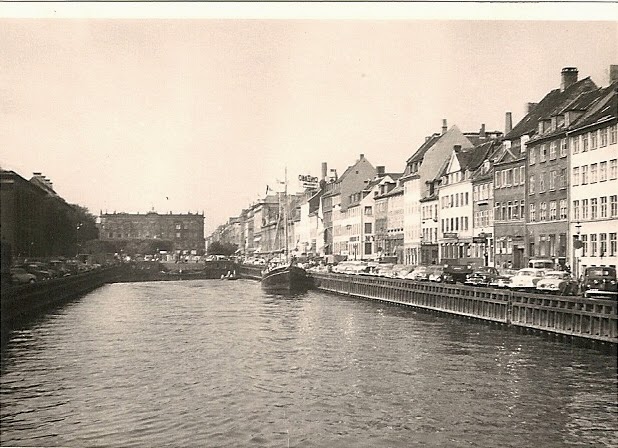
Copenhagen itself was a beautiful city. Many buildings of renaissance style were given a distinctly northern flavour with ornate spires and cupulas covered in copper which gave them a rich green colour. The general atmosphere was one of great friendliness and this was nowhere more apparent than in the famous Tivoli Gardens. There was a party atmosphere at any time of day with its many bars, restaurants and entertainment, plus a modern concert hall, newly built, overlooking the sea. After dark it was even more vibrant with a blaze of coloured lights turning it into a wonderland.

Nyhavn 1950s
Nyhavn, 1956

Amalienborg palace 1950s
Amalienborg Palace

Gefion Fountain 1950s
Gefion Fountain,


Temporary jobs during my Cambridge days

My terms at Emmanuel were filled with studying and rowing though probably more of the latter than the former. During the vacations, particularly the long summer break, the world had to be faced and money had to be earned. Then, as now, the student population provided a pool of casual labour to the economy. Over a period of three years I had a variety of temporary jobs.

I worked on a farm near Cambridge at harvest time and lived in a local pub. Being a farm labourer was hard work with long hours starting very early in the morning which proved particularly difficult after drinking in the pub the following evening. The worst task I was asked to do was to burn a field of stubble armed only with a box of matches and a small tree branch. I had to start in one corner and work my way diagonally across the field, gently beating the flames to keep an even line. This was all very well until the line became longer and longer as I reached the centre. To make matters worse, the hedge surrounding the field caught fire and I had to beat it out with the branch as I kept the rest of it going. Eventually I was left with a small triangle of stubble which petered out, leaving me utterly exhausted.

Roy Lander and John Grinsell
Roy Lander and me
I also worked at a canning factory in Peterborough with my great friend from Emmanuel, Roy Lander. Roy had come to the UK to study from Southern Rhodesia (now Zimbabwe) and was more used to factory work than me. Prior to the harvesting of peas, an army of students were employed to prepare the factory for the receipt of the harvest. I remember spending several days with Roy inside a large cylinder called a pea grader, armed with hand files to smooth down the inside edges of the holes which had been drilled through the outer surface of the drum to allow the smaller peas to fall through. Unless the inside surface was smooth, everything would come out as split peas. So much for the sophistication of the modern industrial process!

As a student of architecture, it was important for me to spend some time on a building site. The first spell was labouring on a local school building project where I had the tough job of unloading bags of cement. The bags were not only extremely heavy but very hot on my back. I did get the chance to use a dumper truck which I rather enjoyed until my knee got in the way of the bucket while tipping builder's rubble. I ended up with a large bruise and a stiff leg for a week so, although I learned little about building techniques, I became familiar with how to 'go on the sick' as a labourer.

At the end of my third year I spent a more profitable time with John Laing Construction in Birmingham on a large multi-storey housing project. I learned much about the problems of building management as I worked in the programming section of a large site office. My job was to inspect the individual dwellings each day to record progress under the various trade headings and stages e.g. carpenter, joiner, plasterer etc. This information was fed into a master progress chart to be set against the original programme. Any delays would immediately affect the building costs with implications for contract value and possible loss of profit. This experience prepared me for the realities of the building industry.


Rowing at Cambridge - Thames Head of the River Race


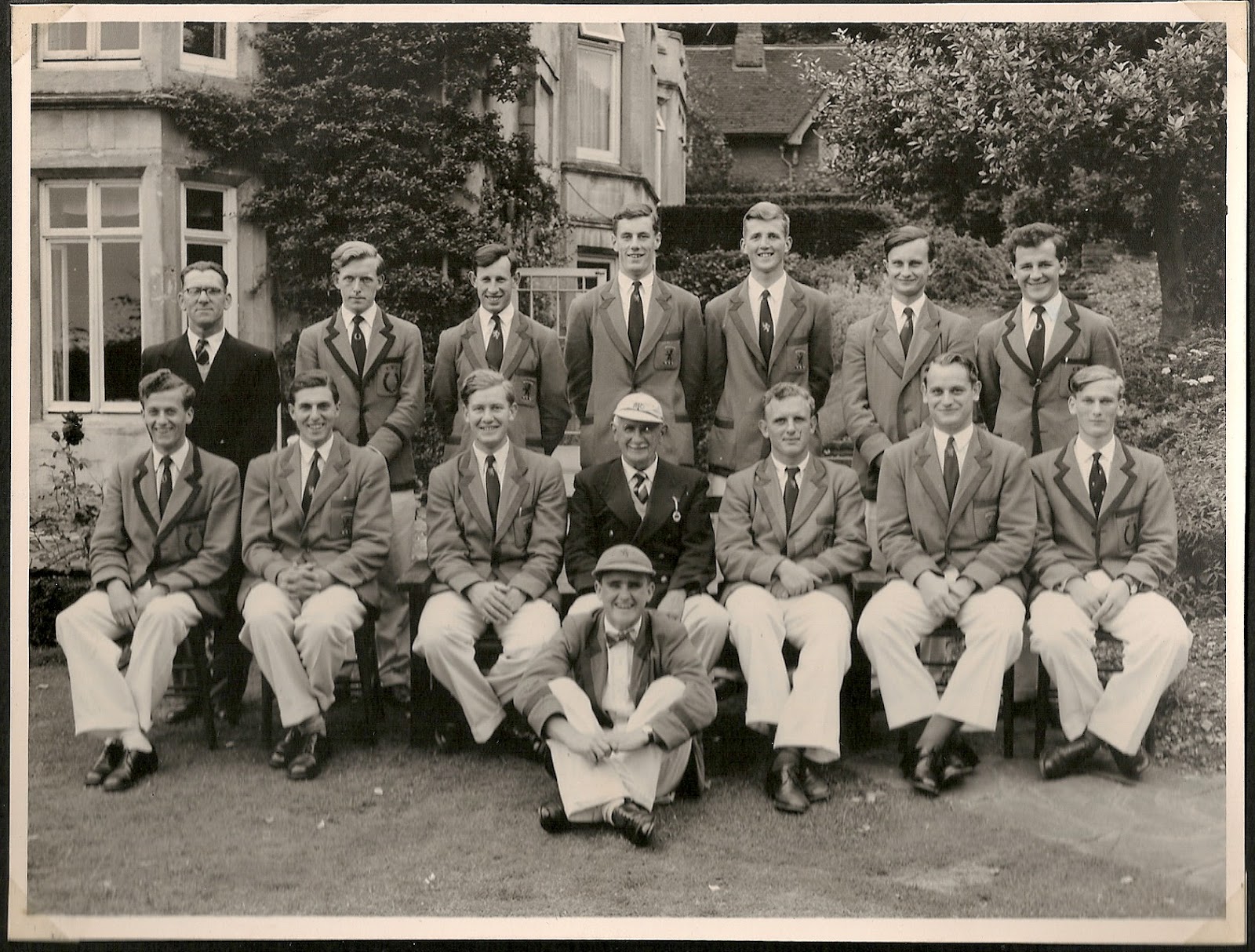
1956 Emmanuel Boat Crew (second eight?).
John is front row, far left.

It was in the lower reaches of the river where I spent most of my time when I wasn't studying. Training usually involved long distance outings covering the length of the river from the boathouses down to the first lock before the river Cam joined the Great Ouse.  On one occasion the first two 'eights' even rowed beyond the lock and carried on down to Ely. The fields adjoining the river were partly flooded and we found ourselves rowing completely off course. We had to row all the way back the following day.

I was a regular member of the second college 'eight' in my first year and took part in national rowing events such as the Thames Head of the River race, which was traditionally rowed the week before the University Boat Race from Mortlake to Putney, and in a coxless four at Henley Royal Regatta. These are experiences I would never forget, not just for the physical exertion involved in both training and taking part, but for the comradeship and sheer fun of the events.

Before the Head of the River race in London we took part in a similar race in Reading the previous week. In the intervening days the two eights rowed downstream through Maidenhead, Henley, Slough and Windsor to Putney, going through several locks and enjoying the beautiful riverbanks of the upper Thames such as Cookham Reach and Teddington. We stayed overnight in Maidenhead and I recall arriving in the pouring rain at about 5 o'clock. The boathouse was adjacent to the main street and we were ordered to run straight to the hotel as soon as we had stored the boat. The sight of sixteen oarsmen and two coxes running down the busy street must have surprised the locals but was nothing compared to the shock of the guests in the hotel when we burst in, bedraggled and soaked-through in our rowing kit. One of our crew, a huge man of 6'6" and 16 stone, loudly requested a hot bath. His name was Bill Hunt, a law student, and I often think of him now as a successful lawyer, frightening the living daylights out of witnesses in court. 

We stayed a couple of nights in a London University hostel before the race on the Saturday. No fewer than 250 crews took part from all over the country so you can imagine the thrill of being involved. Each boat would have to paddle upstream to the starting point, turn round and at 30 second intervals start off back down to Putney, rowing for about 20 minutes to be timed at the finishing post. The fastest crew, usually the Leander Club in those days, would be declared Head of the River. 


1955 Thames Head of the River Race: Emmanuel coming into
the boathouses at Putney. 


Rowing at Cambridge - the bumps and the stunts.

Rowing at Cambridge
The college and its activities formed the focus of my life. Because of my school interest in rowing I made a bee-line for the Boat Club at Emmanuel which was to be the centre of my interests for the next three years. Rowing, although demanding in time, was the perfect antidote for the architecture course which required many hours of studio work. Of all the sports in Cambridge, rowing attracted a wide variety of people: it was the focus of college pride and the social calendar of the university.

Each term produced events on the river which attracted the crowds. The first term, known as Michaelmas, produced the Fairbairn's Cup, named after Nicholas Fairbairn, a legendary oarsman who pioneered a style of rowing which challenged the established technique and influenced all later styles. It was a timed race involving a procession of boats starting from the college boathouses and finishing over 2 miles downstream from Cambridge.

The river is not wide enough to row side by side, so a form of race was devised many years ago known as the 'Bumps'. These are held in the second and third terms (Lent Races and May Races) and each college enters a number of crews competing in a number of divisions. The Bumps are rowed in the opposite direction to the Fairbairn's - boats have to paddle down from their boathouses to be positioned along the river bank, a few yards apart. On a given signal each boat is pushed out into the centre of the river and at the starting pistol as many as 15 crews set off in pursuit of the boat in front (although it's technically behind, as you row backwards!) The object of the exercise is to literally bump the next boat. When that happens the two boats involved stop rowing. There are four days of racing so the following day the two boats involved in the 'bump' swap places in the division.

rowing shield, 1957, Cambridge

Any crew which records four consecutive bumps is said to have 'gained their oars'. The prize for each rower is a full-size oar which he can keep: the blade would be decorated with the names of the full crew in gold lettering on the college colours. The cox of the winning crew is given a decorated rudder and the coach receives a wooden shield with a mock-up of the bow end of the boat. In my final year at university I coached a crew which gained its oars and the shield is one of my prized possessions.

During the summer term the Boat Club attracted many other people who wanted to row in the May Races for fun. The rugby and soccer clubs had a boat, also the medics. There was also a 'Gentleman's' boat which consisted of boat club members who couldn't afford the time to train regularly, particularly in their final year.

At the end of each term there was a special Boat Club dinner called a Bump Supper. These were always well attended and rather rowdy. We always drank far too much and often people would nip out of college into town later in the evening to perform some kind of prank. I was once bold enough to join such a group and was nearly caught by the Proctor and the police trying to push a large cable roller through the town back to college. Other stunts involved capturing one of the swans from the pond and depositing it in someone's room, changing the position of furniture in a room before filling it full of scrunched-up newspaper and a university golf player chipping golf balls from the rear garden over the Sir Christopher Wren designed chapel roof.

On another occasion a friend of mine, who is now a famous QC, somehow climbed up the front of the cinema which was across the road from Emmanuel and removed a huge cardboard cut-out of Elizabeth Taylor. He took this back to his room. The film, rather appropriately, was called 'Giant'.

Cambridge in the 1950s - Religion and Politics.

Cambridge in the 1950s was a hot-bed of social change. Apart from the traditional rivalry between 'town and gown' the post war years encompassed much religious and political activity challenging the establishment.  Evangelism was sweeping the academic world and religious groups were keen to recruit young, open-minded students together with more mature ex-national servicemen with strong anti-war principles, often conscientious objectors.

In my first few weeks as a student at Cambridge I was, like everyone else, bombarded with all manner of information about clubs and societies all wanting to me to join them. Fresher's week was the same in the 1950s as it is now. Each student had his own pigeon-hole adjacent to the Porter's Lodge where he could pick up messages and invitations from sports clubs, obscure religious groups and political activists. I remember once being invited to tea by a third year student and, arriving in my sports gear, was confronted with a small group reading extracts from The Bible. It was all very intense and really not for me. I found the traditional church litany far more comfortable, as represented by the College Chapel.

However Evangelism was not just confined to the non-conformist churches. The vicar of the University Church, Great St Mary's, was, at that time, Dr Mervyn Stockwood who represented the 'left wing' of the Church of England. It came as no surprise, therefore, that Billy Graham, American Christian evangelist, was invited to preach in St Mary's. The church was packed to capacity and I, like many others, religious or not, wanted to witness it.  He had a commanding personality and had the ability to impress a largely academic audience. There were certainly converts to Christianity after his visit, amongst an undergraduate population keen to get involved in new ideas.

Oxford and Cambridge, because they had produced statesmen and eminent politicians over the centuries, always attracted budding political activists. Emmanuel College already had a reputation for being left-wing although this was never evident in terms of producing extreme socialist views of political activity. In fact I found it was more apolitical, at least within my social circle. However the College debating society produced its own political thinkers, some of whom subsequently emerged as national figures. During my time there Cecil Parkinson was a student and Labour supporter but ended up as a senior figure in Margaret Thatcher's Conservative government. Tom King was also at Emmanuel at this time and became Defence Secretary in John Major's government during the Gulf War.

For anyone with political aspirations, membership of the Cambridge Union was a must and, invariably, leading lights were being groomed by the main political parties.  Even the College Debating Society was a showcase for good public speakers. I was always envious of people who could stand up and ad-lib on any subject. I remember once attending a debate on the motion "That Marks and Spencer has done more for civilisation than either Marx or Spenser". Following the main speakers, the debate was open to the floor. In walked one of my contemporaries, fresh from the Cambridge Union, and entered into the debate without knowing what the motion was. He was hugely entertaining, though slightly drunk. His name was Michael Frayn and he was later to become a very successful playwright and author.